


Shop Categories
Your Reviews



Read More
Trade Account Login
REGISTRATION
The history of Fordite
The history of Fordite
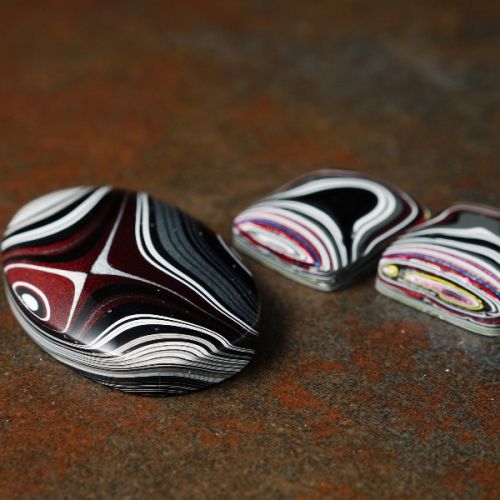 Fordite is becoming ever so fashionable, whether it's becasue it's a piece of motor car history, for it's organic colours or the upcycling aspect I'm not sure, but its has historical significance.
I've just got a hands on a new stock of Fordite cabochons, to create my latest collection of jewellery for my upcoming major shows, Pop up in the Palmhouse, Spring market, in May, and the Hebden Bridge Open Studios in July.
I have been lucky enough to get some orange versions of Fordite from the USA, and one of the questions Iget asked at markets is the history of the pieces and the colours.
Fordite is a by-product of painting cars. also known as Detroit Agate or Motor City Agate, first discovered in the Michigan Ford factory in the 40's, hence it's name.
Fordite is the result of layers and layers of enamel car paint that has cured and built up over decades.
In the 1930s cars were spray painted by hand, and the over spray of this process would collect on the racks, walls and floors of the car painting booths. When placed in ovens to cure the paint onto the vehicles, the excess paint would bake and solidify too, with the process being repeated thousands of times, the layers of the overspray would form becoming very thick slabs, hindering and obstructing the work within the spray booths so it would have to be scrapped off.
One day some of the workers realised that these deposits could be salvaged, and when cut and polished revealed striking organic patterns that could be used as keepsakes and set in metals, like a gemstone, to create unique pieces of jewellery.
Fordite, known for its vibrant colours and intricate organic patterns, is sought after by collectors for its unique appearance and historical significance especially as it displays the populariry of certain car colours through the decades.
In the 30s and 40s, the colours are mainly dark and neutral:
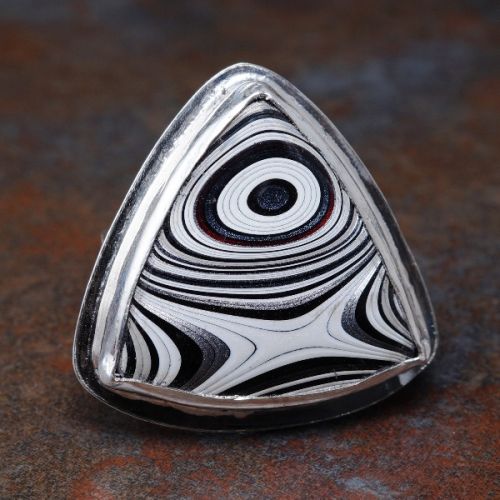
Monochrome trillion ring made from Fordite from the 30s and 40s
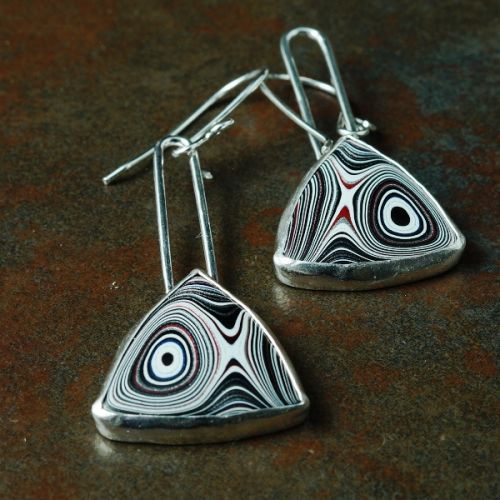
Trillion earrings made from dark monochrome Fordite from the 40s and 50s
In the 60s and 70s Fordite is a lot brighter due to the demand for colourful cars:
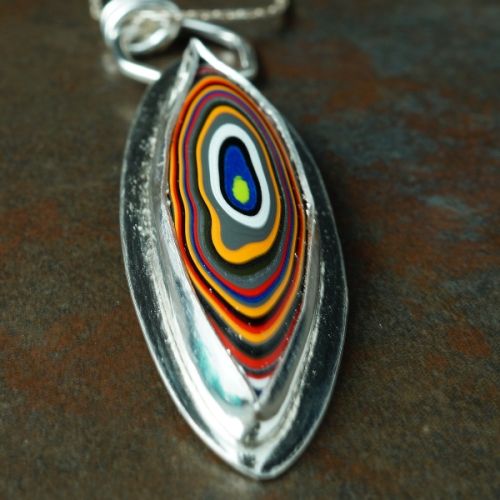
Vibrant Marquise Pendant from 60s and 70s Fordite
Fordite was produced in abundance until the late 70s, when new techniques were developed to apply paint to cars with little or no overspray, so in over words the source of this has now ceased to exist, as the mines are now closed.
These thick slabs of enamel strata, are natural stratigraphic records of the American car manufacturing industry, with every stripe being a timestamp of a factory run, stacked like a colourful sediment.
It takes approximately a 1000 layers of paint to create just one inch of Fordite, it's even been dubbed a technofossil, a marker of anthropocene, accidental geology.
The colour palette show the different colours where popular fo each car manufacture over time, Corvette colours are vivid and bright, with sparkly paint containing metalllic flecks, Jeep Fordite, Jeepite, tend to be outrageous and rare to find.
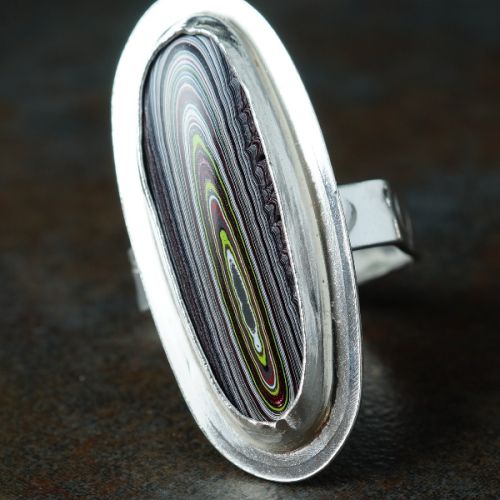
Fine and Sterling SIlver elongated oval ring made with Fordite from the 60s and 70s
Fordite jewellery is a pretty cool piece of wearable art to own, especially for those who are into cars, and loves to won a bit of history.
Check out my latest pieces within the Fordite Collection.
What's your thoughts
Joolz xxxx
0 Comments


